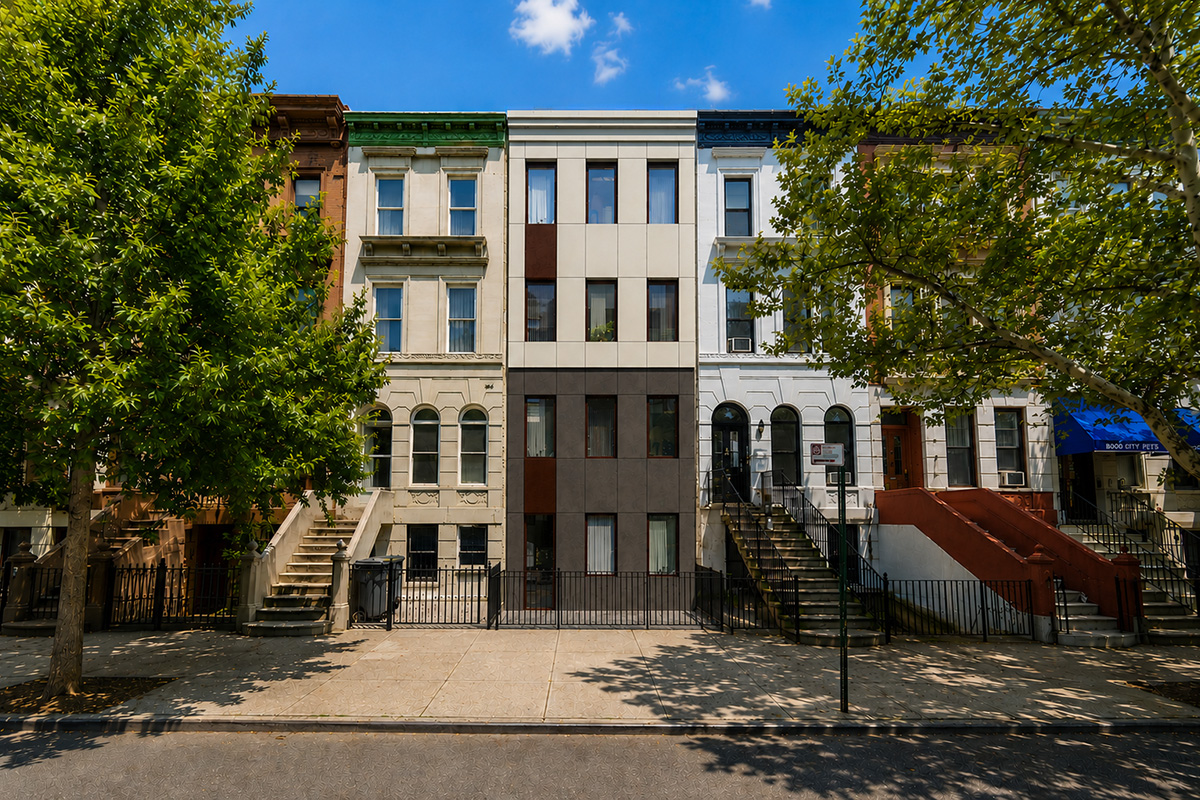
Building a new townhouse in NYC requires careful coordination between zoning analysis, architectural design, DOB approvals, engineering, and construction planning. Every property presents unique constraints and opportunities that influence the building envelope, floor area, massing, circulation, and overall development strategy. Ground-up townhouse construction in New York City involves extensive technical and regulatory requirements that shape the project from the earliest stages of feasibility analysis through construction.
Building a townhouse on a vacant lot in New York City requires a comprehensive understanding of zoning regulations, site limitations, structural systems, code requirements, and urban construction logistics. New townhouse development in NYC often involves complex zoning conditions that determine the allowable floor area, building height, unit count, rear yard requirements, and overall configuration of the building.
I am Jorge Fontan, owner of Fontan Architecture, a Manhattan-based architecture firm specializing in high-end residential projects including townhouse design in New York City. Our firm approaches new townhouse development with a strong emphasis on design quality, technical execution, and detailed coordination throughout the entire process. At Fontan Architecture, design and technical development are addressed together through a coordinated process that integrates zoning analysis, building systems, construction detailing, and spatial design into a cohesive architectural project. This article focuses primarily on the technical and procedural aspects of developing a new townhouse in New York City, including zoning analysis, DOB filings, building systems, and construction coordination.
Table of Contents
Assessing A Vacant Lot For Townhouse Development
Before purchasing a vacant lot or redevelopment property in NYC, we typically recommend performing an architectural feasibility analysis to evaluate zoning regulations, development limitations, site conditions, and overall construction potential. Early property analysis establishes what can legally and practically be built on the site before significant financial commitments are made toward acquisition, design, or construction.
New townhouse development in New York City is heavily influenced by zoning regulations that control floor area ratio (FAR), building height, rear yard requirements, lot coverage, setbacks, occupancy classification, and permitted unit count. Site dimensions such as lot width and lot area can significantly affect the development potential of a property. In many cases, zoning limitations determine whether a site can support a one-family townhouse, two-family home, or multifamily building.
Vacant lots and redevelopment properties may also involve landmark regulations, easements, flood zone requirements, utility coordination, and neighboring structural conditions. Existing conditions on neighboring properties can directly influence structural design, excavation strategy, and construction sequencing for a new townhouse project.
Working with an architect during the pre-acquisition phase of a property purchase can provide valuable clarity regarding the development potential and limitations of a site. An architect can perform preliminary zoning analysis, review DOB records, assess development constraints, and help determine whether a property aligns with the client’s goals before acquisition. Early feasibility analysis often identifies critical limitations that may substantially affect the design, budget, approvals process, or overall viability of a project.
Zoning Analysis For Building A Townhouse In NYC
Zoning analysis establishes the framework for new townhouse construction in New York City. Every property has specific zoning requirements that regulate allowable building size, building height, rear yard dimensions, lot coverage, setbacks, occupancy classification, and permitted residential use.
Many townhouse development sites in NYC are located on narrow urban lots with dimensional limitations that significantly affect the development potential of the property. In some cases, an underlying zoning district may technically permit multifamily construction while the specific zoning lot dimensions restrict the site to one- or two-family development.
Floor Area Ratio, commonly referred to as FAR, is one of the primary factors that determines the allowable size of a new townhouse. FAR regulations establish the amount of zoning floor area permitted on the site relative to the lot size. Additional zoning requirements may influence building envelope shape, street wall height, setback conditions, and rear yard depth. Understanding these limitations at the beginning of a project helps guide the architectural design, project scope, unit configuration, and overall development strategy.
Hiring An Architect For A Townhouse Project
Many townhouse projects in NYC benefit from involving an architect early in the process, including during property evaluation and pre-acquisition due diligence. Architectural analysis before purchasing a property can help identify zoning limitations, development constraints, structural considerations, and regulatory conditions that may significantly affect the feasibility and overall direction of a project.
During the pre-acquisition phase, an architect can review zoning regulations, assess allowable floor area, evaluate building envelope limitations, review DOB records, and identify potential challenges related to landmark status, flood zones, easements, or neighboring structures. Early analysis can provide valuable clarity regarding what can realistically be built on the site before acquisition decisions are finalized.
Once a property is acquired, the architect typically leads the development of the project through zoning analysis, schematic design, construction documentation, DOB filings, consultant coordination, and construction administration. Ground-up townhouse projects in NYC require extensive coordination between architectural design, structural engineering, building systems, code compliance, and construction detailing throughout the development process.
Our high-end townhouse projects are highly customized to the client’s goals, lifestyle, and long-term plans for the property. Early collaboration between the client and architect allows the project to develop with a clear understanding of both the technical requirements and the architectural objectives of the townhouse from the beginning of the process.
Programming And Planning A New Townhouse
Once we establish the zoning parameters and development limitations for a property, we move into programming and architectural design. Programming is the process of establishing the spatial, functional, and operational requirements of the townhouse before detailed design development begins. At this stage, we work closely with the client to understand how they want to live in the home, how the building will function, and what priorities will shape the overall organization of the project.
When we design a new home for one of our clients, we approach the project as a fully customized architectural response to their lifestyle, priorities, and long-term goals for the property. We develop each house specifically around how the client intends to live within the home, entertain guests, use private and public spaces, and experience the residence on a daily basis. During the design process, we carefully study circulation, spatial and functional relationships, natural light, storage, outdoor space integration, and the overall organization of the home to align with the client’s lifestyle, routines, and preferences. This level of personalization allows the townhouse to function as both a highly refined residence and a direct reflection of the client’s way of living.
Townhouse design in New York City requires careful planning due to the vertical nature of the building and the dimensional limitations of urban lots. We study stair placement, structural layout, natural light access, floor-to-floor relationships, and zoning envelope constraints early in the process. During programming and schematic planning, we often explore multiple layout strategies to determine the most effective organization for the project before advancing into detailed architectural design.
Programming and planning establish the foundation for the entire townhouse design process. Our goal during this phase is to align zoning regulations, structural systems, building performance, spatial organization, and architectural intent into a cohesive and well-coordinated project before proceeding into detailed design.
Options And Upgrades For A New Townhouse In NYC
When we design a new townhouse in NYC, we evaluate a wide range of architectural features, building systems, and lifestyle upgrades that can significantly influence how the home functions and how the spaces are experienced over time. Ground-up construction creates opportunities to integrate these elements from the beginning of the design process.
Roof decks are one of the most common upgrades in new townhouse construction and can introduce valuable outdoor living space within dense urban environments. We carefully coordinate roof decks with structural systems, waterproofing, drainage, guardrails, stair access, and overall architectural composition to integrate the outdoor space cohesively into the design of the home.
Elevators are another important consideration in many multi-story townhouse projects. Incorporating an elevator early in the planning process allows us to coordinate shaft placement, circulation patterns, structural systems, and floor layouts efficiently throughout the building. Elevators can significantly improve accessibility, long-term functionality, and overall comfort within a vertical residence.
Natural light is often a major focus in townhouse design due to the depth and density of urban lots in New York City. We frequently study opportunities for larger rear façade openings, oversized windows, skylights, interior glass, and other strategies that improve daylight penetration throughout the residence. The placement and proportion of windows and skylights significantly influence the spatial quality and overall experience of the home.
New townhouse projects may also incorporate highly customized kitchens, smart home systems, radiant floor heating, integrated lighting controls, and advanced HVAC systems. These elements require careful coordination between architecture, structural engineering, mechanical systems, and construction detailing early in the design process.
When we develop a new townhouse for a client, we evaluate these options as part of a comprehensive architectural strategy tailored specifically to the property, the client’s goals, and how they intend to live within the home.
Designing the Home
When we design a new townhouse for one of our clients, we begin by developing a clear understanding of how they want to live within the home and what architectural character best aligns with their goals for the residence. We approach each townhouse as a fully customized architectural project shaped around the property, the surrounding context, and the client’s lifestyle, priorities, and aesthetic preferences. Every townhouse presents unique opportunities for both interior and exterior design, and we develop each project as a bespoke residence tailored specifically to the individual homeowner. Our design process begins with the client’s goals and extends through every aspect of the architecture, from the overall massing and façade composition down to interior planning, materials, detailing, and spatial experience.
When designing a townhouse in New York City, we carefully study how the building relates to the streetscape, neighboring structures, and the broader architectural context while also considering how the residence functions internally on a daily basis. We evaluate the organization of public and private spaces, vertical circulation, natural light, outdoor space integration, and façade composition as part of a cohesive architectural strategy. Our goal is to create a residence that balances function with a strong architectural identity and a clear sense of material quality and spatial continuity throughout the home.
The rendering below illustrates one approach we developed for a contemporary townhouse within a historic Upper East Side context. The property is located within a designated Landmark District where new construction must respond carefully to the surrounding architectural character. For this project, we designed a façade that references the proportions, materiality, and compositional order of traditional limestone townhouses while maintaining a restrained and contemporary architectural language.
We use limestone to establish a sense of permanence and contextual continuity within the streetscape, while introducing warmth with bronze-framed windows, doors, and integrated metal panels which add a contemporary layer to the composition. Our goal was to create a townhouse that feels grounded within the architectural character of the Upper East Side while clearly expressing an updated interpretation of the classic townhouse design.
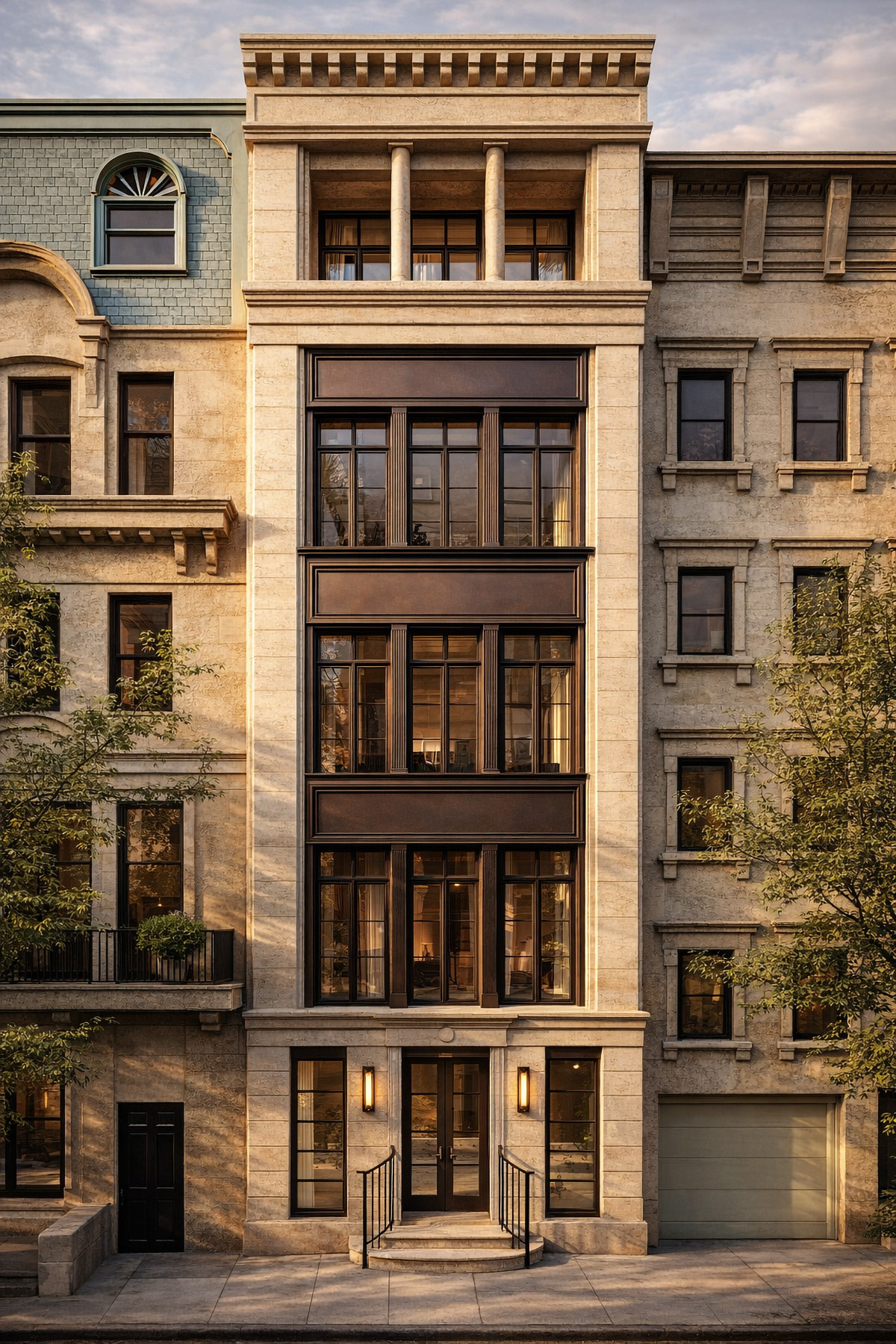
New Manhattan Townhouse Design
DOB Filing And New Building Applications
Ground-up townhouse construction in NYC requires filing a New Building application with the NYC Department of Buildings. New Building applications involve extensive coordination between the architect, engineers, and other consultants involved in the project.
DOB filing requirements typically include zoning analysis, architectural plans, structural coordination, mechanical, electrical, plumbing, energy code compliance, construction documentation, and technical detailing necessary for approvals. Depending on the property and scope of work, projects may also require coordination with the Landmarks Preservation Commission or other regulatory agencies.
Discretionary Approvals And Regulatory Considerations
Some new home construction projects in New York City require approvals beyond standard DOB filings depending on the zoning conditions, landmark status of the property, or the scope of the proposed development. Early evaluation of these regulatory conditions is an important part of the feasibility and planning process because discretionary approvals can significantly influence project scope, timeline, and overall development potential.
Properties located within designated Landmark Districts often require review and approval from the New York City Landmarks Preservation Commission. Exterior work visible from the public way may require a Certificate of Appropriateness or other LPC approvals depending on the scope of the project. When we design townhouses within landmark districts, we carefully study the surrounding architectural context, façade composition, material palette, and historic character of the streetscape while developing an architectural approach appropriate to the property and the neighborhood.
Some townhouse projects may also involve discretionary zoning approvals such as variances or special permits when existing zoning regulations create practical limitations on the proposed development. These approvals require detailed zoning analysis, supporting documentation, and extensive regulatory review.
Our firm has experience successfully obtaining discretionary approvals for residential development projects in New York City, obtaining multiple rezoning approvals and variances from the Board of Standards and Appeals. Variance applications require careful coordination between zoning analysis, architectural design, supporting documentation, and the broader development strategy for the property. In these situations, zoning and architecture become closely interconnected parts of the overall project planning process.
One discretionary approval we obtained was a floor area variance for a new townhouse project in Williamsburg, Brooklyn. On this project the property the owners purchased was quite small and the zoning regulations limited the size of the home which would make it notably smaller than the surrounding existing homes. Due to this unique condition we were able to demonstrate the practical hardship necessary to support the variance application.
When evaluating a property for new townhouse construction, we review potential regulatory and discretionary approval requirements early in the process to help establish realistic development expectations and identify potential challenges before detailed design work begins.
Structural And Construction Considerations For New Townhouses
Building a townhouse in NYC involves significant structural and construction coordination due to the complexity of urban construction sites and the proximity of neighboring buildings. Excavation, foundations, underpinning, shoring, and structural framing all require careful planning and engineering coordination.
Urban construction sites often present logistical challenges related to site access, material staging, neighboring properties, construction sequencing, and DOB compliance. These site conditions directly influence both the construction process and the architectural development of the building.
Structural systems, exterior wall assemblies, waterproofing, insulation, and façade detailing must all be coordinated together to achieve a durable and high-performing building envelope. Successful townhouse construction requires close collaboration between the architect, engineers, contractors, and consultants throughout the project.
Selecting A Contractor For A New Home Construction Project
Selecting the right contractor is one of the most important decisions in the process of building a townhouse in NYC. New townhouse construction requires extensive coordination between the architect, contractor, engineers, consultants, and subcontractors throughout the project. The contractor plays a major role in construction quality, schedule management, site coordination, and overall execution.
When we work with clients on new townhouse projects, we assist during the contractor selection and bidding process. Depending on the project, this may involve negotiating with a preferred contractor or coordinating a competitive bidding process between multiple general contractors. During this phase, we review contractor qualifications, prior project experience, staffing, construction approach, scheduling, and pricing structure as part of the overall evaluation process.
Townhouse construction in New York City presents logistical and technical challenges that require experience with dense urban construction conditions. Excavation, underpinning, neighboring properties, material staging, DOB compliance, and site access all require careful planning and coordination.
Construction Administration And Project Execution
The architect’s role in a new townhouse project continues throughout construction and project completion. During construction, we work closely with the contractor, consultants, and client to help coordinate the execution of the project and maintain alignment between the design intent and the built work.
Construction administration typically involves site visits, coordination meetings, shop drawing review, responding to contractor questions, reviewing material submittals, and coordinating with engineers and consultants as construction progresses. This phase of the project requires continuous communication and coordination between all parties involved in the construction process.
New townhouse construction in NYC also involves multiple inspections, sign-offs, and regulatory approvals throughout construction and prior to occupancy. Depending on the project scope, this may include DOB inspections, special inspections, energy code compliance verification, and sign-offs from various technical disciplines associated with the project.
Before a new townhouse can be occupied, the project must obtain a Temporary Certificate of Occupancy or Final Certificate of Occupancy from the NYC Department of Buildings. Careful coordination during construction helps support a smoother closeout process and successful completion of the townhouse.
Building A New Townhouse In NYC
Building a new townhouse in NYC requires balancing zoning constraints, technical requirements, construction realities, and architectural intent within one of the most complex urban environments in the world. Ground-up townhouse development involves a highly coordinated process that begins with feasibility analysis and continues through architectural design, DOB approvals, technical detailing, and construction execution.
Well-designed townhouses create efficient urban living environments with strong spatial organization, durable materials, carefully proportioned façades, and integrated outdoor spaces. Every aspect of the project, from zoning analysis to waterproofing details, contributes to the long-term quality and performance of the building.
Fontan Architecture works on high-end residential projects throughout New York including designing new townhouses and detached homes. Our firm approaches each project with a focus on design excellence, technical coordination, and careful execution throughout the architectural process.
Request a Consultation with Fontan Architecture - 212 321 0194
Jorge Fontan, AIA, is an architect and founder of Fontan Architecture based in New York City. The firm focuses on residential design, including new homes and extensive renovations for discerning clients. Through collaborative dialogue that draws on the individuality of each client, projects develop as distinct architectural responses guided by thoughtful planning, precise detailing, and a commitment to creating enduring value.
Jorge Fontan, AIA, is an architect and founder of Fontan Architecture based in New York City. The firm focuses on residential design, including new homes and extensive renovations for discerning clients. Through collaborative dialogue that draws on the individuality of each client, projects develop as distinct architectural responses guided by thoughtful planning, precise detailing, and a commitment to creating enduring value.