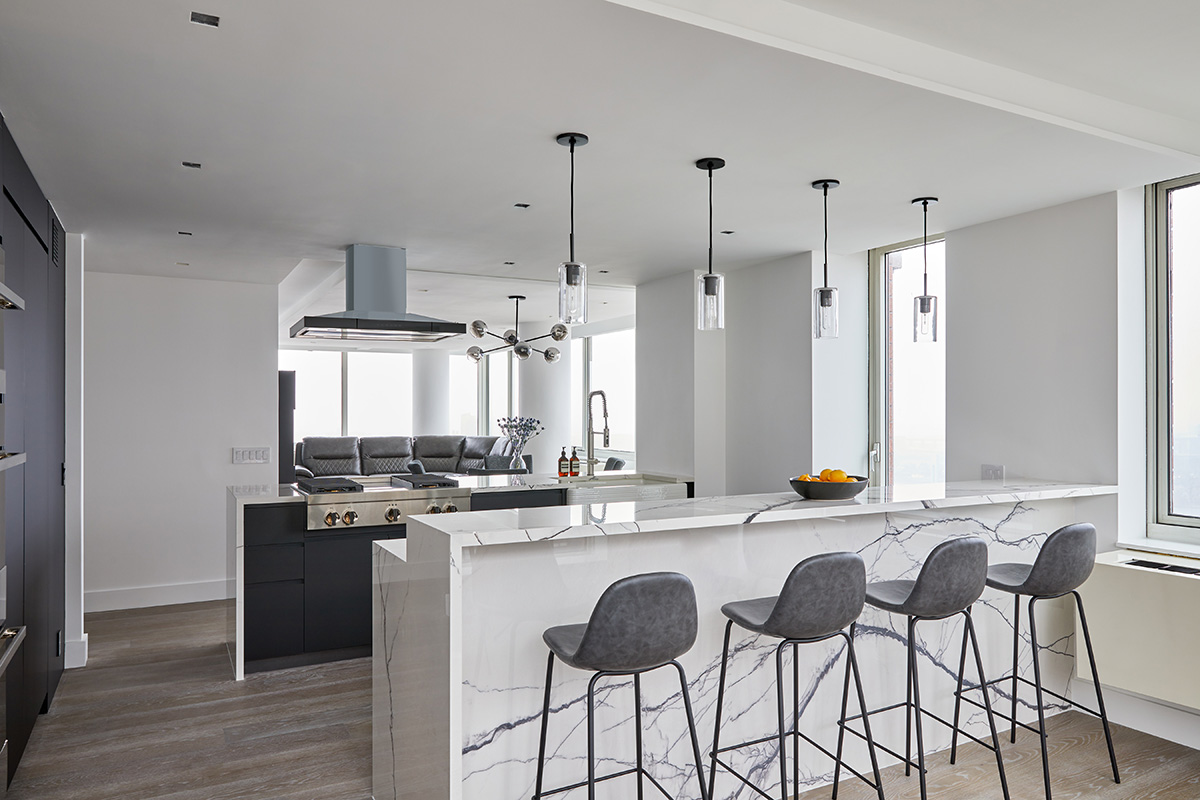
Renovating a cooperative apartment in New York City requires more than design decisions. These projects are governed by alteration agreements, board approvals, building-specific restrictions, and Department of Buildings regulations that directly influence scope, timeline, and budget.
Comprehensive co-op renovations often involve full reconfiguration of layouts, mechanical upgrades, and detailed coordination with both the building and the city. Early planning and disciplined execution are essential to navigating this layered approval process successfully.
As an architect practicing in New York City, I have worked on numerous co-op renovations throughout Manhattan. The following outlines the architectural, procedural, and investment considerations involved in renovating a co-op apartment.
Table of Contents
Architectural Services for a Co-Op Renovation
Co-op apartment gut renovations require early architectural involvement. Before formal filings or contractor engagement, the existing conditions, building constraints, long-term spatial objectives, and design aesthetics must be evaluated and planned holistically.
In cooperative buildings, architectural drawings are typically required for board review and Department of Buildings filings. These submissions establish the scope of work, demonstrate code compliance, and form the basis for regulatory approval. Engaging an architect at the outset allows feasibility, budget expectations, and building requirements to be aligned before construction planning begins.
Architectural services may extend beyond design and filings to include consultant coordination, contractor selection assistance, procurement guidance, and construction administration. The depth of involvement varies by firm and project scope, but in larger renovations, continuity from feasibility through construction oversight is essential to maintaining design intent and managing complexity.
Alteration Agreements
In cooperative buildings, renovation work is governed by an Alteration Agreement executed between the shareholder and the board. This document establishes the parameters under which construction may proceed and defines the responsibilities of all parties involved.
Alteration Agreements typically address project schedule, work hours, protection of common areas, insurance requirements, contractor qualifications, indemnification provisions, and procedures for damage claims. In many buildings, the board retains its own architect or engineer to review proposed plans and monitor compliance throughout construction.
Because these agreements vary significantly from building to building, they directly influence both project scope and timeline. Early review of the Alteration Agreement allows architectural planning to align with building requirements before formal submissions begin. For a broader overview of how condo and co-op renovation approvals are structured in New York City, see our article on NYC Condo and Co-Op Renovation Board Approvals and Planning.
Defining the Scope of Work
Establishing the scope of work is a critical early phase in any co-op renovation. Rather than approaching the project as a series of isolated alterations, successful renovations are defined holistically — evaluating layout reconfiguration, systems upgrades, scope depth, and level of finish together.
In many New York City co-op apartments, particularly older prewar buildings, complete renovations involve full-gut reconfiguration to modernize systems, improve circulation, and align the residence with contemporary living patterns. In some cases, this scope may also include combining adjacent units to create a larger residence — a process that introduces additional regulatory and structural considerations discussed in our article on apartment combinations in New York City.
Early scope definition allows architectural planning, board coordination, and budget expectations to be calibrated appropriately. Establishing clarity at this stage reduces revisions later in the approval process and supports a more disciplined execution during construction.

Home office Renovation with Modern Wood Paneling
Architecture and Design Integration
In co-op renovations, architecture and interior design cannot be separated from regulatory and structural considerations. Layout decisions influence plumbing infrastructure, ceiling conditions affect lighting strategy, and millwork integration impacts both code compliance and spatial continuity. A successful renovation requires these elements to be developed in coordination rather than in isolation.
A fully integrated architectural approach allows the residence to be conceived as a cohesive environment integrating spatial hierarchy, material transitions, storage integration, lighting design, and mechanical systems to ensure clarity and continuity throughout the apartment.
In many co-op apartments, comprehensive renovations involve full reconfiguration of rooms, upgraded systems, and custom interior elements designed specifically for the space. Thoughtful detailing, proportion, and material selection contribute to a residence that feels intentional and enduring rather than pieced together over time.
Full-service architectural involvement — from feasibility through construction administration — ensures that design intent, technical execution, and regulatory compliance remain aligned. This continuity is particularly important in cooperative buildings, where constraints and approvals influence decisions at every stage of the project.
When architecture, interiors, and technical systems are developed as an integrated whole, the result is a renovation that is both structurally disciplined and personally tailored.

Bathroom in a Manhattan Co-Op Apartment Combination
Co-Op Board Review and Approval
In cooperative buildings, renovation work is subject to formal board review prior to construction. Architectural drawings, scope descriptions, and supporting documentation are submitted for evaluation in accordance with the building’s alteration agreement and house rules.
In many cases, the board retains its own architect or engineer to review proposed plans and issue comments. This third-party review may address layout modifications, plumbing relocation, wet-over-dry conditions, structural alterations, and compliance with building-specific restrictions. Responses and revisions are often required before final approval is granted.
The duration and complexity of board review vary significantly between buildings. Some approvals proceed efficiently, while others involve multiple rounds of comments and clarification. Early architectural coordination and clearly defined scope materially reduce delays and facilitate a smoother review process.
Understanding the board’s expectations at the outset is essential to aligning design intent with procedural requirements.
Department of Buildings Review and Permitting
Following board approval, renovation projects requiring filing proceed to review by the New York City Department of Buildings. Architectural drawings and supporting documentation are submitted for examination to verify code compliance and regulatory alignment.
Depending on scope, filings may be processed as an Alteration Type 2 or, in cases involving egress, use, or occupancy adjustments, as an Alteration Type 1. The complexity of the proposed work directly influences the depth of review and overall approval timeline.
Once the filing is approved, construction permits are issued under the licensed general contractor. The sequencing of board approval, DOB review, and contractor permitting must be carefully coordinated to maintain project momentum and avoid unnecessary delays.
In larger-scale co-op renovations, early technical coordination significantly streamlines the approval process.
Contractor Selection and Coordination
In cooperative buildings, general contractors must satisfy building requirements prior to commencing work. This typically includes submission of trade licenses, certificates of insurance, and compliance documentation in accordance with the building’s alteration agreement. Many co-ops also require contractors to execute agreements directly with the board or managing agent.
For larger-scale renovations, contractor selection is a strategic decision rather than a transactional one. The scope, finish level, and degree of structural or systems reconfiguration must align with the contractor’s experience and operational capacity. Firms accustomed to comprehensive, design-driven renovations are better equipped to coordinate complex schedules, manage building constraints, and maintain execution quality.
Architectural involvement during contractor selection helps align construction expertise with project scope and budget expectations. This coordination ensures that design intent, regulatory compliance, and execution standards remain consistent throughout the renovation.
Co-Op Renovation Cost
The cost of renovating a co-op apartment in New York City varies based on size, scope, and finish level. Full-gut co-op renovations of high quality frequently begin around $650 per square foot, with highly customized projects incorporating bespoke detailing reaching or exceeding $1,000 per square foot.
In larger prewar co-op apartments, renovation budgets commonly fall within the $1.5M–$3M+ range, particularly when, particularly when structural reconfiguration, systems upgrades, and custom detailing are involved.
Early budget alignment during the feasibility phase is essential to ensure that design ambition and investment level are appropriately calibrated.
Working With an Architectural Team on a Co-Op Renovation
Co-op renovations require coordinated architectural planning, regulatory navigation, and disciplined execution. Scope, timeline, and budget must be aligned early in the process to ensure that design intent, board requirements, and construction logistics move forward cohesively.
Successful projects depend on collaboration between architect, contractor, consultants, and building representatives — particularly in cooperative environments where governance and review layers influence decision-making at every stage.
Fontan Architecture provides full-service architectural design for large-scale residential renovations in New York City, guiding projects from feasibility assessment through design development, approvals, and construction administration.
For property owners considering a co-op renovation, early consultation allows scope definition, regulatory pathway, and investment alignment to be established before formal design begins.
Request a Consultation with Fontan Architecture - 212 321 0194
Jorge Fontan, AIA, is an architect and founder of Fontan Architecture based in New York City. The firm focuses on residential design, including new homes and extensive renovations for discerning clients. Through collaborative dialogue that draws on the individuality of each client, projects develop as distinct architectural responses guided by thoughtful planning, precise detailing, and a commitment to creating enduring value.


Jorge Fontan, AIA, is an architect and founder of Fontan Architecture based in New York City. The firm focuses on residential design, including new homes and extensive renovations for discerning clients. Through collaborative dialogue that draws on the individuality of each client, projects develop as distinct architectural responses guided by thoughtful planning, precise detailing, and a commitment to creating enduring value.