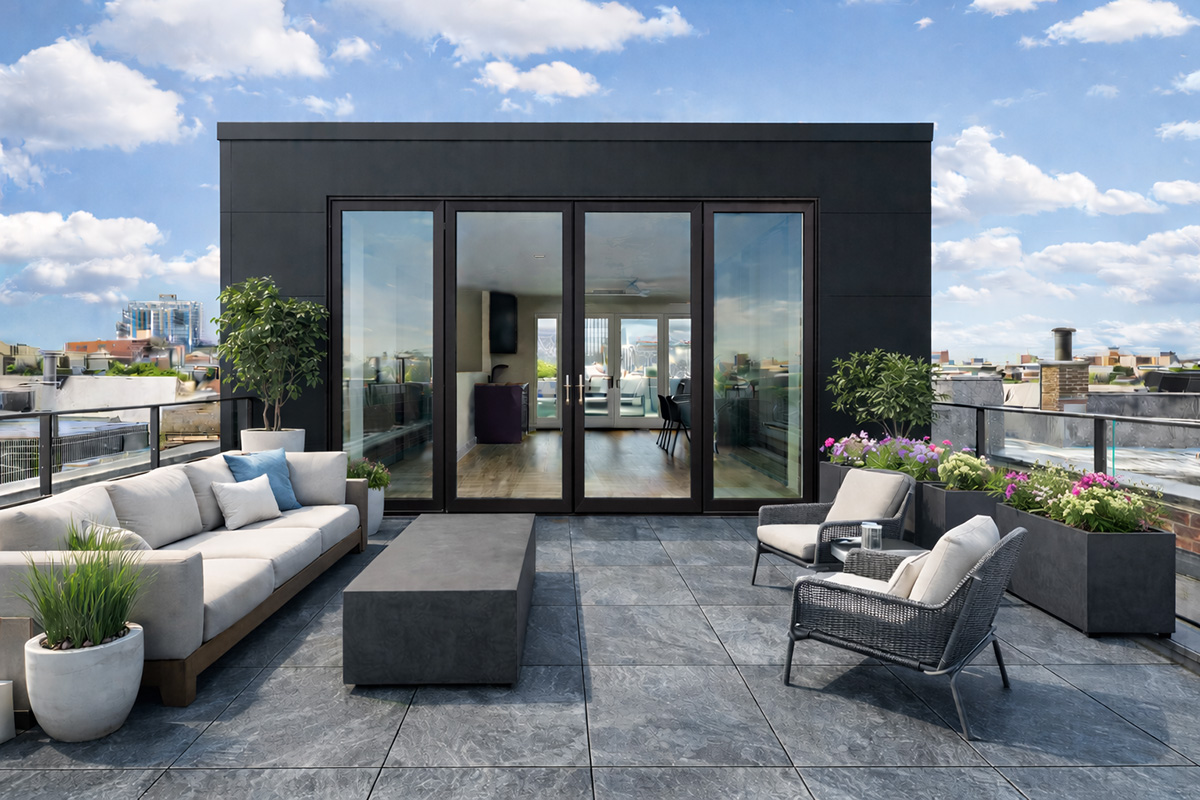
Rooftop additions on brownstones and townhouses in New York City present a unique architectural condition where expansion occurs within the constraints of historic context. Many of these properties are located within designated landmark districts, where alterations and additions are subject to review by the New York City Landmarks Preservation Commission. Rooftop additions introduce new volume above existing structures, requiring careful consideration of visibility, proportion, and the relationship between the historic building and the proposed intervention. The design of these additions requires a disciplined approach that integrates regulatory context with architectural intent.
Rooftop additions on brownstones and townhouses within New York City landmark districts are permitted when the proposal is approved by the Landmarks Preservation Commission and complies with the New York City Zoning Resolution, including LPC requirements related to visibility and appropriateness.
I am Jorge Fontan, owner of Fontan Architecture, a Manhattan-based architecture firm specializing in high-end residential renovations. Our work on landmark brownstones and townhouses involves the design and execution of complex rooftop additions developed in coordination with the Landmarks Preservation Commission. We approach each project as a bespoke response to the client, aligning architectural design with the client’s lifestyle, priorities, and long-term vision for the property. Rooftop additions require a comprehensive process that addresses design, regulatory approvals, structural integration, and construction execution as a unified effort. Our focus is on producing well-resolved architectural compositions that maintain the integrity of the existing building while introducing new space that is appropriate to the project and aligned with our clients’ goals.
Table of Contents
Landmarks Review
Rooftop additions on landmark brownstones and townhouses in New York City are reviewed by the New York City Landmarks Preservation Commission through one of two processes: Staff Level Review or Full Commission Review. The applicable review path is determined by the scope and visibility of the proposed work and its relationship to established Landmarks criteria.
Staff Level Review applies to proposals that fall within clearly defined parameters established by the Commission and are evaluated against specific criteria, including limitations on visibility and the relationship of the addition to the existing building. When a proposal meets these criteria, it may be approved at the staff level without a public hearing.
Full Commission Review applies to proposals that fall outside the parameters for staff-level approval and are presented at a public hearing for review by the full Commission.
Approval Process: Prescriptive or Discretionary
The distinction between Staff Level Review and Full Commission Review extends beyond procedure and has a direct impact on how approvals are determined. Staff-level applications are evaluated against clearly defined criteria established by the New York City Landmarks Preservation Commission. When a proposal satisfies these requirements, approval can be granted at the staff level without the need for further review, creating a more predictable and efficient approval process.
Full Commission Review operates under a different framework. These applications are presented at a public hearing and evaluated by the Commission as a whole. Approval is not determined by a fixed set of prescriptive criteria, but by an assessment of the project as a complete architectural composition. In this context, proposals may be approved, modified, or denied based on the Commission’s discretionary evaluation of the design, its relationship to the existing building, and its contribution to the surrounding context.
This distinction also affects project timelines. Staff-level applications are typically reviewed more quickly due to their alignment with established parameters. Projects subject to Full Commission Review involve a longer and more variable timeline, as they require scheduling for public hearing and may proceed through multiple rounds of review. The duration of this process is closely tied to the development of the design and the extent to which the proposal is refined through the Commission’s evaluation.
Staff Level Review Criteria
Staff Level Review for rooftop additions on landmark brownstones and townhouses is governed by clearly defined criteria established by the New York City Landmarks Preservation Commission. These parameters establish the limits within which an addition can be approved at the staff level and have a direct influence on the design, massing, and placement of the proposed work.
Rooftop additions qualifying for staff-level approval are limited to a single additional story above the existing building. Within this condition, rooftop decks may be incorporated as part of the addition when they are integrated into the overall design and remain within the established height and visibility constraints. We have designed and completed rooftop additions on landmark brownstones that incorporate a rooftop deck within this single-story limitation, developed in coordination with the New York City Landmarks Preservation Commission and constructed in accordance with staff-level approval criteria.
Height is also specifically controlled. The addition may not extend more than eleven feet above the midpoint of the existing roof. This restriction defines the vertical envelope of the project and requires careful coordination of floor-to-floor heights, structural depth, and roof assemblies to achieve a functional and well-proportioned space within a limited volume.
Visibility remains a determining factor in staff-level approval. For buildings under seven stories, the addition must not be visible from the public thoroughfare, regardless of facade orientation. This requirement has a direct impact on the setback and overall placement of the addition, requiring precise study of sightlines and the relationship of the new construction to the existing roofline.
Discretionary Full Commission Review
Any proposed addition that does not fully comply with the prescribed limitations is subject to Full Commission Review. In this context, the proposal is evaluated through a discretionary process in which the design is assessed as a complete architectural composition. This review may require further development and refinement of the proposal, and approval is not guaranteed. Proposals may be approved, modified, or denied based on the Commission’s evaluation of the design in relation to the existing building and its context.
Documentation and Architectural Representation
Rooftop additions in landmark districts require a comprehensive set of drawings and visual materials developed to communicate the proposed work in relation to the existing building and its context. Our submissions to the New York City Landmarks Preservation Commission include architectural plans, elevations, and detailed studies of the proposed addition, along with illustrative materials that convey how the project will be perceived from the public way.
We document existing conditions and incorporate historic research where appropriate to inform the evaluation of the proposed work. As part of the Landmarks review process, we coordinate the construction of a full-scale physical mockup on site to study and demonstrate the visibility and placement of the rooftop addition. This mockup is reviewed in the field by an LPC representative as part of the approval process and is a critical component in evaluating how the proposed work will be perceived from the public way.
This work is developed as part of the architectural process. We use these materials to study, refine, and communicate the design, ensuring that each proposal is resolved with clarity and can be evaluated as a complete architectural composition.
Rooftop additions that achieve approval are typically designed with a level of restraint in massing and placement that prioritizes the original architecture and provides a visual hierarchy of the existing building.
Rooftop Additions on Landmark Brownstones and Townhouses
Rooftop additions on landmark brownstones and townhouses in New York City require a careful integration of regulatory constraints and architectural design. The distinction between Staff Level Review and Full Commission Review establishes two fundamentally different approval pathways, one defined by clear parameters and the other by discretionary evaluation. Visibility, massing, and overall composition are central to both processes, shaping how rooftop additions are positioned and designed within the context of the existing building and the surrounding streetscape.
Rooftop additions are one component of a broader category of townhouse expansions in New York City, which often involve both zoning and landmark considerations. For a broader overview of this topic, see our article on townhouse additions in NYC.
These projects demand a comprehensive and coordinated approach that addresses design, approvals, and construction as a unified process. The development of drawings, mockups, and supporting materials is integral to evaluating and refining the proposal, ensuring that the work is resolved with clarity and can be reviewed as a complete architectural composition. Successful rooftop additions balance programmatic goals with the constraints of landmark regulation, resulting in additions that are both approvable and well integrated with the historic structure.
Fontan Architecture works on rooftop additions for landmark brownstones and townhouses throughout New York City. Our projects are developed through a rigorous design process that aligns architectural intent and client objectives. We guide clients through the Landmarks approval process and the full execution of the project, from initial design through construction, with a focus on producing well-resolved architectural work appropriate to each property.
Projects of this nature benefit from early architectural evaluation, particularly in the context of landmark properties where feasibility and design direction are closely linked. We have also written about the value of consulting with an architect prior to purchasing a townhouse in New York City.
Request a Consultation with Fontan Architecture - 212 321 0194
Jorge Fontan, AIA, is an architect and founder of Fontan Architecture based in New York City. The firm focuses on residential design, including new homes and extensive renovations for discerning clients. Through collaborative dialogue that draws on the individuality of each client, projects develop as distinct architectural responses guided by thoughtful planning, precise detailing, and a commitment to creating enduring value.
Jorge Fontan, AIA, is an architect and founder of Fontan Architecture based in New York City. The firm focuses on residential design, including new homes and extensive renovations for discerning clients. Through collaborative dialogue that draws on the individuality of each client, projects develop as distinct architectural responses guided by thoughtful planning, precise detailing, and a commitment to creating enduring value.