
Renovating a residence in New York City is a complex undertaking. Even projects that appear straightforward often involve layered approvals, technical coordination across multiple disciplines, and careful reconsideration of existing spatial conditions. In a market where residential property represents a significant financial investment, renovation decisions carry lasting implications for both quality of life and long-term asset value.
A well-conceived renovation establishes order. It clarifies circulation, refines proportion, strengthens material integrity, and aligns construction with long-term objectives. Architectural oversight brings discipline to these decisions, coordinating technical requirements with spatial intent and ensuring that the project translates into lasting quality.
I am Jorge Fontan, Architect and owner of Fontan Architecture, a New York City–based practice focused on high-quality residential architecture and interiors. Our work centers on the thoughtful reconfiguration of existing spaces, balancing regulatory expertise with spatial clarity and sophisticated design. The following outlines the role of the architect in high-level NYC renovations — particularly where scope, complexity, and property value warrant comprehensive leadership.
Table of Contents
Property Acquisition and Pre-Renovation Assessment
Architectural involvement begins long before a renovation formally starts. In New York City, the decision to acquire a property — or to substantially reinvest in one already owned — warrants thorough evaluation.
Apartments and townhouses frequently carry constraints that are not immediately visible: structural limitations, utility access, mechanical restrictions, landmark considerations, egress deficiencies, or building-specific alteration policies. What appears to be a simple reconfiguration may involve significant regulatory or technical complexity.
An architect can assist in evaluating:
- The feasibility of proposed layout changes
- Structural implications of wall removal
- Plumbing relocation limitations
- Mechanical system capacity
- Building and board constraints
- Landmark restrictions
- Code compliance exposure
In acquisition scenarios, this assessment can materially influence purchasing decisions. The ability to confirm whether a property can accommodate intended spatial changes — additional bedrooms, expanded kitchens, reoriented primary suites — protects against investing in a property that cannot support the owner’s long-term objectives.
For existing owners considering renovation, a formal architectural assessment clarifies scope before design begins. It distinguishes between cosmetic updates and meaningful spatial reconfiguration, aligning investment with outcome.
In high-value residential markets, renovation begins with evaluation — not demolition.
Architectural Vision and Design
Following a complete assessment of the property, the next step is establishing the architectural vision. Design is the articulation of a clear and enduring direction for the residence — one that guides decisions from overall function to the smallest details.
A meaningful renovation begins with dialogue. A truly custom home is shaped around its occupants — their lifestyle, priorities, sensibilities, and aspirations. In a full gut renovation, the residence should support how the owners live while reflecting who they are. Developing this vision requires careful listening, perceptive questioning, and thoughtful interpretation. Through close collaboration, the architect translates lived experience into an architectural language that feels natural and deeply personal.
Architectural vision defines the character of the home. It informs the selection and refinement of materials, the proportion and presence of millwork, the quality of transitions between rooms, and the way light settles into each space. Texture, balance, and detail are considered together so that the home feels unified rather than assembled. In one townhouse we are currently renovating, the overarching concept for the home is “urban resort” which emerged through dialogue with the owners — a shared aspiration for calm within the city. That idea now shapes material warmth, spatial rhythm, and atmosphere throughout the residence.
In substantial residential work, the strength of the concept provides continuity. When the vision is clear, the home feels grounded and complete. There should be a sense that every element belongs — that the home could not have been built in any other way.
Architecture at this level requires both discipline and empathy. The architect’s role is to bring together constraints, aspirations, and context into a cohesive direction — creating a residence that endures and feels unmistakably its own.
Custom Home Design
Design Development and Engineering
Once the architectural direction has been established, the work moves into development. This is where ideas are refined, and developed into something that can be constructed with precision.
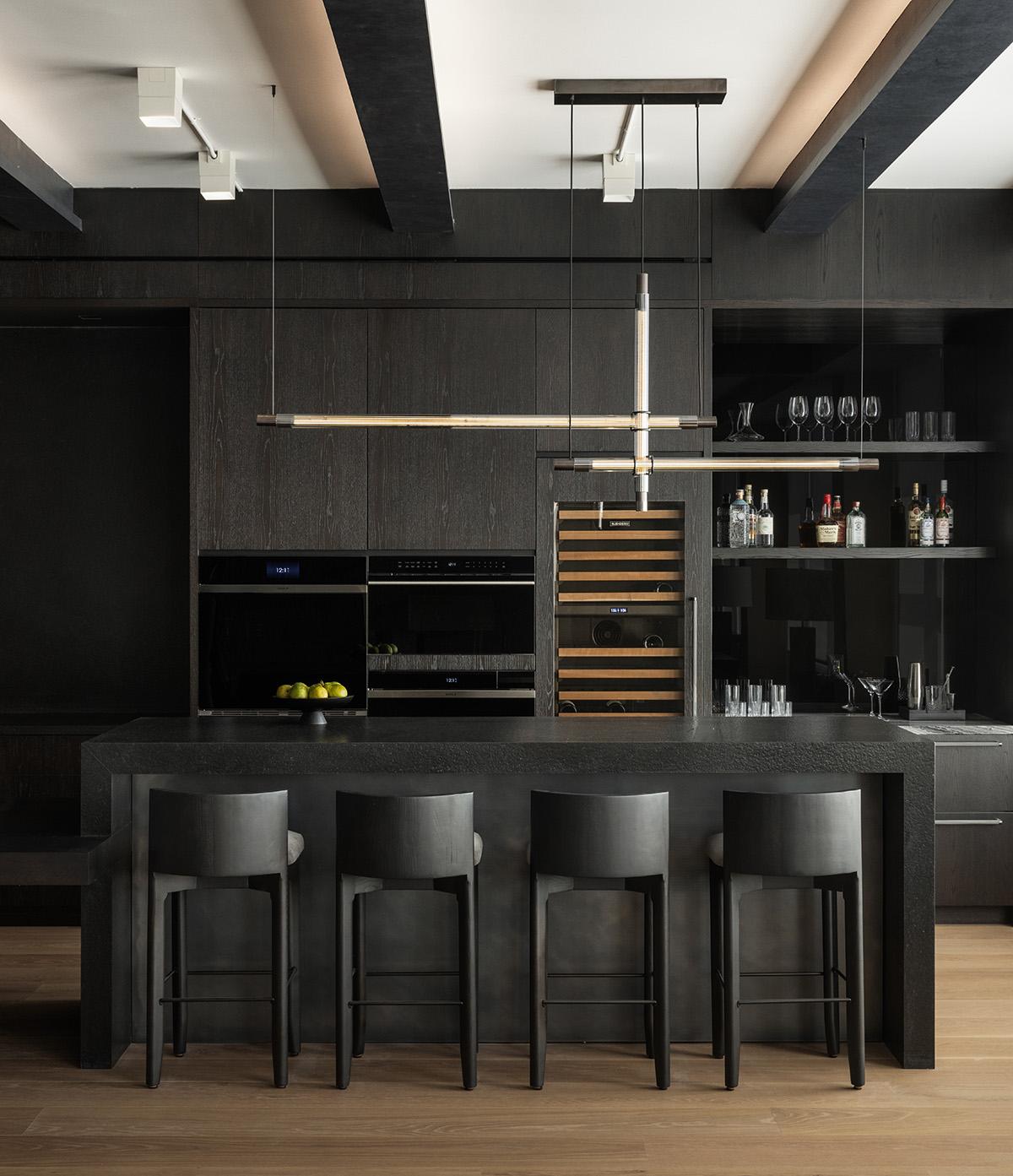
During this phase, the design becomes increasingly detailed. Layouts are finalized and materials studied more closely, with custom millwork detailed to align with the architectural direction. Kitchens and bathrooms are resolved down to material transitions and finite detailing. Lighting is considered not only for performance, but for mood and balance throughout the day and evening.
At the same time, engineering coordination begins in earnest. Structural and mechanical systems are evaluated to ensure adequate heating, cooling, and ventilation. Plumbing layouts are aligned with both design intent and building constraints. Electrical planning is coordinated to support both performance and the architectural intent.
By the end of design development, the renovation has moved from concept to commitment. The project is documented in detail, aligned with consultants, and prepared for filing and construction. What began as a conversation has become a clear, coordinated plan.

Bespoke Bathroom in a Modern Apartment
Regulatory Framework and Required Filings
Renovating in New York City requires careful attention to the regulatory environment. The city’s building codes and approval processes are detailed, and most substantial alterations require formal filing with the NYC Department of Buildings. In cooperative and condominium buildings, renovations also undergo extensive review by building management and the board.
These submissions form an essential part of the renovation process. They document existing conditions, clearly define the proposed work, and confirm compliance with building code, zoning regulations, and life-safety standards. For co-ops and condominiums, the review process also ensures alignment with building policies and operational considerations.
Meticulous documentation reduces uncertainty, supports contractor execution, and safeguards against budgetary overruns. Rather than slowing the process, thoughtful preparation allows the renovation to move forward with assurance and reduces the risk of future conflicts.
Building Governance: Co-Ops and Condominiums
Renovations in co-op and condominium buildings require board approval and coordination with building management. Submissions typically include:
- Comprehensive architectural drawings and all required submissions to relevant agencies
- Scope of work documentation
- Contractor insurance and licensing
- Alteration agreements
- Compliance with building-specific technical standards
Boards frequently engage their own architect or engineer to review proposed work.
In this context, precision and clarity are essential. Drawings must anticipate structural, fire-rating, sound attenuation, and mechanical implications. Misalignment between proposed work and building policy can delay projects significantly.
Architectural leadership helps ensure that submissions are technically sound and strategically presented.
Landmark and Historically Significant Properties
Work within landmarked properties demands additional care.
Exterior modifications, visible alterations, and in some cases interior changes require review by the Landmarks Preservation Commission. Material selection, detailing, and proportion must respect the architectural character of the building while accommodating contemporary living standards.
In these contexts, renovation is not reinvention. It is calibration — a careful balance between preservation and refinement.
Bidding and General Contractor Selection
With completed construction documents in place and approvals underway, the project enters the bidding phase. This stage determines who will ultimately build the work. Contractors are typically selected through a competitive bidding process, although some clients elect to proceed with direct selection.
Contractor selection involves evaluating experience, craftsmanship, management skills, communication style, and familiarity with the specific project type, level of design, and budget. In New York City, experience working within occupied buildings, coordinating with management, and navigating logistical constraints is essential.
A structured bidding process creates clarity. Selected contractors are invited to price the same detailed drawings and specifications, allowing proposals to be reviewed on equal footing. We analyze overall cost alongside scope alignment, allowances, and schedule.
The relationship between owner, architect, and contractor extends over many months, often more than a year. Professionalism, transparency, and aligned expectations are critical to a successful collaboration.
When managed carefully, the bidding phase establishes expectations early. It confirms that the contractor understands the design intent, the level of finish required, and the logistical realities of the building. It also allows adjustments to be made before construction begins, when decisions are most efficient.
Selecting the appropriate general contractor is one of the most important decisions in a renovation. A strong partnership supports the design, maintains momentum, and safeguards the owner’s investment throughout construction.
Construction Oversight and Design Integrity
During construction, architectural oversight serves several functions:
- Review of contractor submittals and shop drawings
- Clarification of details
- Evaluation of field conditions
- Review of change order requests
- Protection of design intent
- Quality control
- Review and approval of GC payment requisitions
Without oversight, subtle compromises accumulate. Misaligned millwork, poorly resolved transitions, and imprecise lighting placement can dilute an otherwise well-conceived design.
In high-investment renovations, attention to these details distinguishes a truly refined home built to an elevated standard.
Long-Term Value
A residence functions both as a home and as a significant financial asset. When an owner commits the time, capital, and energy required for a major renovation or new construction, the outcome should justify that investment.
Achieving that result depends on assembling the right team and maintaining the appropriate level of design leadership and oversight throughout the process. With thoughtful planning, disciplined execution, and clear architectural direction, the finished home can provide lasting satisfaction while strengthening its long-term value.

Custom Black Metal and Glass Doors in NYC Loft
Architectural services
Renovating a residence in New York City requires technical competence, regulatory fluency, spatial intelligence, and a deep ability to translate vision to design. In projects of meaningful scope and investment, architectural leadership provides structural rigor and design coherence.
At Fontan Architecture, we guide clients through each of these phases — from early due diligence through comprehensive design and construction oversight — ensuring that complex renovations are executed with clarity, precision, and care.
Request a Consultation with Fontan Architecture - 212 321 0194
Jorge Fontan, AIA, is an architect and founder of Fontan Architecture based in New York City. The firm focuses on residential design, including new homes and extensive renovations for discerning clients. Through collaborative dialogue that draws on the individuality of each client, projects develop as distinct architectural responses guided by thoughtful planning, precise detailing, and a commitment to creating enduring value.



Jorge Fontan, AIA, is an architect and founder of Fontan Architecture based in New York City. The firm focuses on residential design, including new homes and extensive renovations for discerning clients. Through collaborative dialogue that draws on the individuality of each client, projects develop as distinct architectural responses guided by thoughtful planning, precise detailing, and a commitment to creating enduring value.