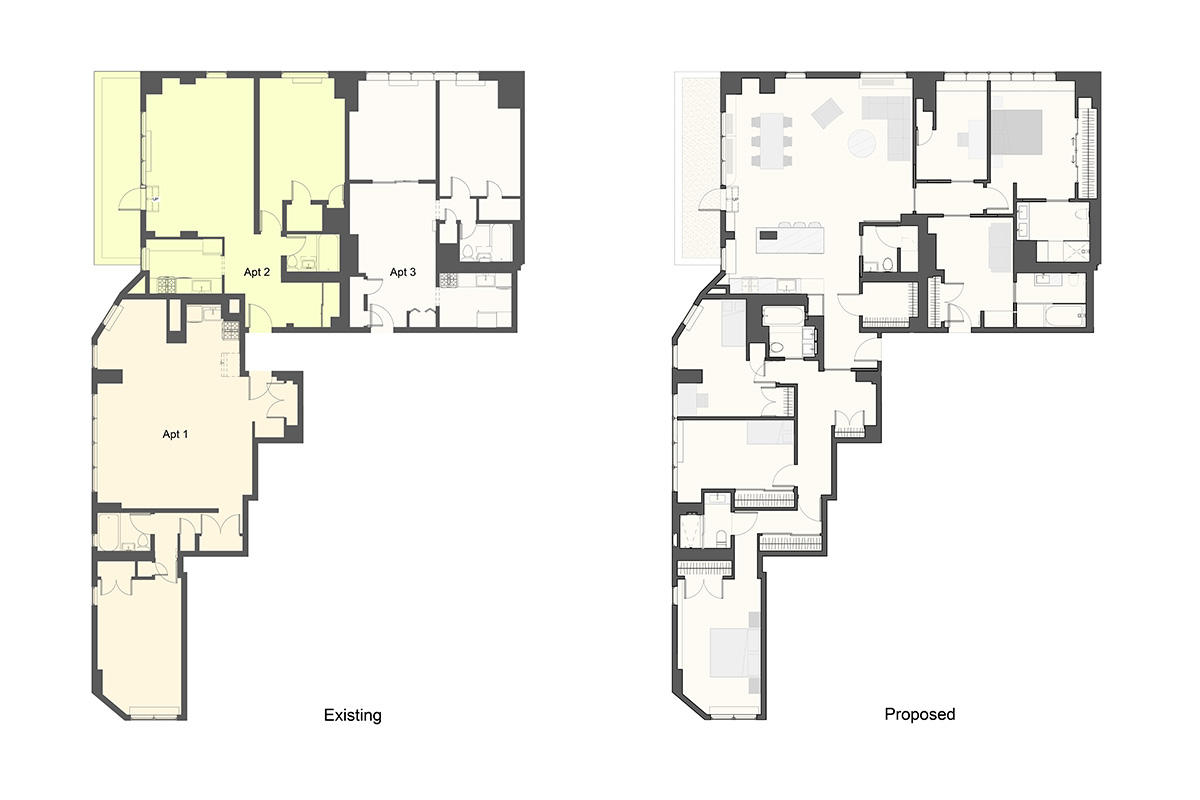
Combining apartments can create opportunities to transform multiple smaller units into a larger, more functional residence while remaining within an established building. We are currently combining three separate condominium apartments into a single home on the Upper West Side of Manhattan. The residence evolved over time as the owners acquired neighboring units, including an adjacent studio and a one-bedroom apartment across the hall. Because all three units are located at the end of the corridor, the project also includes the acquisition of a portion of the common hallway, creating a practical connection between the apartments while maintaining the functionality of the building.
Apartment combinations are a highly effective way to obtain a larger, more functional home in New York City. In many buildings, particularly on the Upper West Side, opportunities to purchase large apartments are limited, while neighboring units occasionally become available over time. A successful apartment combination results in a cohesive home that feels as though it was conceived as a single residence.
I am Jorge Fontan, owner of Fontan Architecture, a New York City architecture firm specializing in high-end residential design. We have worked on numerous apartment combinations, loft renovations, townhouse renovations, and full-gut residential projects throughout Manhattan and New York City. Our approach combines thoughtful design, technical expertise, and close coordination throughout the design and construction process to create highly individualized homes tailored to the lifestyle, priorities, and aspirations of each client.
Table of Contents
Combining Apartments on the Upper West Side: Planning and Pre-Purchase Consultation
This project is located on West 68th Street on Manhattan’s Upper West Side. It began with a one-bedroom condominium apartment that our clients owned. Over time, they acquired the adjacent studio apartment, which is when they first hired us to help create a larger home while remaining within the same building. When a neighboring one-bedroom apartment located across the hall became available for purchase, they recognized an opportunity to further expand the residence and create a substantially larger home.
Before moving forward with the acquisition, our clients engaged us to evaluate the feasibility of combining all three apartments into a single residence, including the potential purchase of a portion of the common corridor. At this stage, the project involved much more than purchasing an additional unit. The success of the apartment combination depended on understanding how the apartments could be physically connected, whether the building would support the proposed configuration and corridor acquisition, and how the resulting residence could function as a cohesive home. By becoming involved early in the process, we were able to help our clients identify opportunities and constraints before they made significant financial commitments.
A key component of the strategy involved acquiring a portion of the common hallway located outside the apartments. Because the units were situated at the end of the corridor, purchasing hallway rights created an opportunity to establish a logical connection between the apartments without affecting circulation for other residents on the floor. We worked closely with our clients to evaluate the feasibility of this approach and establish a path forward before the purchase was completed. This type of early architectural evaluation can be invaluable when considering an apartment combination, as discussed in our article on Consulting with an Architect Before Planning an Apartment Combination in New York City.
Apartment Combinations and Cohesive Design
The primary design challenge of an apartment combination is not physically connecting three apartments. The greater challenge is creating a home that feels as though it was always designed as a single residence. Successful apartment combinations require much more than opening walls and creating new doorways. Without careful planning, the resulting home can retain a fragmented character, with awkward circulation patterns, disconnected spaces, and a layout that obviously reveals how the apartments were assembled over time.
Our goal is to make the complexity of the apartment combination disappear. Although this residence began as three separate condominium units connected by a common corridor, we approach the design as though we are creating a new home from scratch. Every decision is evaluated within the context of the complete residence rather than the boundaries of the original apartments. The organization of public and private spaces, circulation routes, room proportions, sightlines, architectural detailing, and material continuity are all carefully considered as part of a unified composition.
A critical part of this process is understanding our clients and how they want to live. Every apartment combination presents unique opportunities, but no two families use their homes in exactly the same way. Before developing layouts and architectural solutions, we spend time understanding our clients’ lifestyle, priorities, routines, and aspirations for the home. Decisions regarding the organization of living spaces, private areas, entertaining, storage, workspaces, and circulation are all shaped by how the residence will be experienced on a daily basis. We develop highly individualized design solutions based on both the property and the people who will live there.
One of the principles that guides our work is the idea that the most refined homes feel natural and inevitable. The best apartment combinations do not feel like combinations at all. They feel as though they were always intended to exist in their final form. Our objective is to create a home with a sense of effortless elegance, where the spaces feel intuitive, cohesive, and completely at ease. Achieving that result requires extensive planning, restraint, coordination, and thoughtful decision-making. We carefully consider every aspect of the design, from circulation and room organization to architectural detailing, material transitions, lighting, and visual continuity, integrating them into a unified whole. The ultimate success of the project will be measured not by the complexity of the work involved, but by how naturally the home functions and whether anyone can tell it was once three separate apartments.
Condominium Approvals, Tax Lot Mergers, and Alteration Agreements
While the design goal is to create a home that feels effortless and unified, apartment combinations also require extensive coordination beyond the architectural design itself. In addition to the design considerations discussed above, these projects involve approvals, filings, building regulations, and administrative requirements that must be addressed throughout the process. We discuss these broader considerations in more detail in our article on Combining Apartments in New York City: Scope, Planning, and Approvals.
Because this is a condominium building, the project requires the consolidation of the existing condominium tax lots. In New York City, combining condominium apartments is not simply a matter of connecting the units through construction. The legal property records must also be updated so that the newly combined residence is recognized as a single condominium unit. As part of this process, we coordinate the required Department of Finance filings and documentation necessary to establish a new combined tax lot for the residence.
The project also requires close coordination with the condominium board, property management, and the building’s governing documents. The proposed acquisition of a portion of the common hallway requires condominium approval and careful review of how the corridor space will be transferred and incorporated into the residence. In addition, the apartment combination must comply with the building’s alteration agreement, which establishes requirements for construction procedures, insurance, work hours, material deliveries, protection of common areas, and coordination with building management throughout the project.
One of the advantages of involving an architect early in the process is that these issues can be evaluated before major decisions are made. Understanding condominium approvals, tax lot requirements, alteration agreement restrictions, and filing obligations helps establish a realistic path forward and allows the architectural design to develop within a clearly defined framework. By addressing these considerations early, we can focus on creating a cohesive home while minimizing potential obstacles during approvals and construction.
Our Full-Service Approach to Apartment Combinations
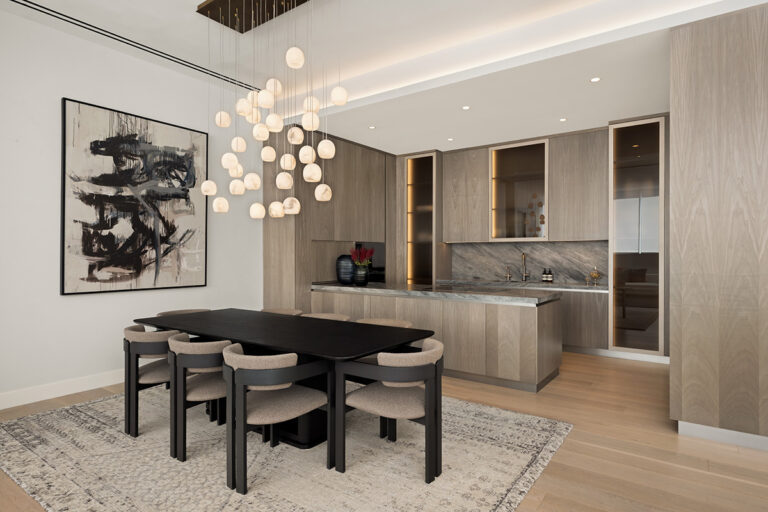
Apartment combinations are most successful when architecture, interiors, lighting, and technical coordination are developed together as part of a unified design process. Because our firm provides full-service residential design, we approach the project holistically rather than treating the architecture and interiors as separate exercises. This allows us to coordinate the layout, architectural detailing, materials, lighting, millwork, and construction requirements as a cohesive whole from the earliest stages of design.
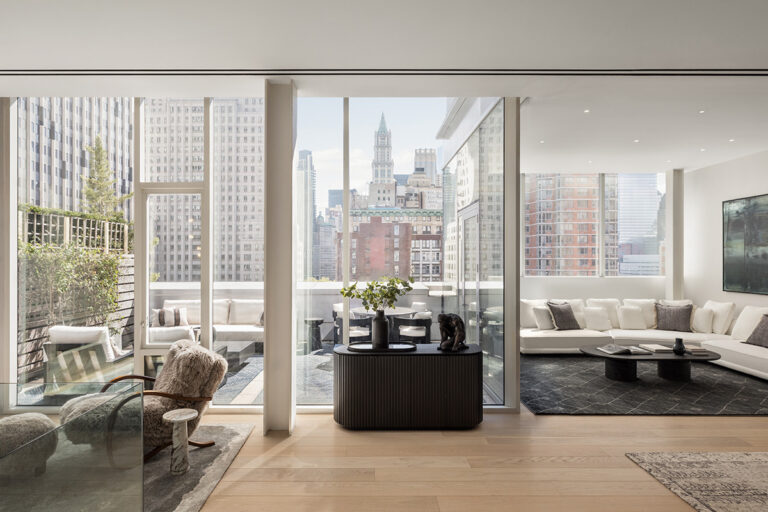
One of the primary concerns our clients expressed during the design process was the quality of light throughout the home. Natural light is an important consideration in any residence, but it becomes particularly significant in apartment combinations where the layout and circulation patterns are being completely reimagined. We carefully studied how the home would be experienced throughout the day and developed a layered lighting strategy designed to support both functionality and atmosphere.
The lighting design incorporates multiple systems working together throughout the residence. Recessed lighting provides general illumination, while decorative sconces introduce warmth and visual interest. We integrated linear LED light strips into the architecture to create subtle layers of indirect illumination and highlight key design elements. We also incorporated low-level baseboard lighting within portions of the circulation spaces, providing gentle nighttime illumination and enhancing the overall experience of moving through the home. Rather than relying on a single lighting solution, each layer contributes to a more refined and comfortable environment.
This integrated approach extends beyond lighting. We coordinate the architecture, interiors, materials, detailing, and building systems together so that every element contributes to the larger composition. The goal is not simply to expand the residence, but to create a cohesive home where the design feels natural, comfortable, and thoughtfully resolved. When all of these elements are developed together, the residence feels unified and effortless, reinforcing the sense that it was always intended to exist as a single home.
Construction Administration and Project Oversight
Designing an apartment combination is only part of the process. As the project moves into construction, our role continues through construction administration, allowing us to help guide the project from design through completion. Apartment combinations involve extensive coordination between contractors, consultants, building management, and ownership, making ongoing architectural oversight an important part of achieving the intended result.
For this Upper West Side apartment combination, construction administration includes reviewing construction progress, responding to field conditions, coordinating with the contractor, reviewing shop drawings and submittals, and helping ensure that the design is executed in accordance with the construction documents. As with most large-scale residential renovations, unforeseen conditions can emerge once demolition begins. Maintaining continuity between the design process and construction allows challenges to be addressed while preserving the overall architectural vision for the home.
Construction administration is particularly important on projects where the goal is to create a residence that feels as though it was always intended to exist in its final form. Achieving that level of cohesion requires careful attention to details that are often refined and coordinated throughout construction. Material transitions, millwork integration, lighting details, architectural alignments, and finish execution all contribute to the final experience of the home.
We remain actively involved throughout construction to help ensure that the completed residence reflects the design objectives established at the beginning of the project. The goal is not simply to complete the construction work, but to create a home that feels natural, unified, and thoughtfully resolved in every detail.
Upper West Side Apartment Combination Architect
This Upper West Side apartment combination demonstrates how a home can evolve over time through thoughtful planning, strategic acquisitions, and careful architectural design. What began as a one-bedroom apartment expanded through the acquisition of neighboring units and a portion of the common corridor, creating the opportunity to transform three separate condominium apartments into a single residence.
Projects such as this require much more than connecting apartments together. They involve architectural planning, condominium approvals, tax lot mergers, alteration agreements, and extensive coordination throughout the design and construction process. Most importantly, they require a clear design vision that allows the completed residence to function as a cohesive home rather than a collection of previously separate spaces.
At Fontan Architecture, we approach apartment combinations as an opportunity to create highly individualized homes tailored to our clients and their properties. Through careful planning, thoughtful design, and close coordination, our goal is to make the complexity disappear so that the final result feels natural, unified, and effortless. Apartment combinations represent one aspect of our residential design practice on Manhattan’s Upper West Side. Learn more about our approach to residential architecture in our article on Upper West Side Residential Architect: High-End Townhouses & Apartments. The most successful apartment combinations are the ones that no longer feel like combinations at all, but rather homes that appear as though they were always meant to be exactly as they are.
Request a Consultation with Fontan Architecture - 212 321 0194
Jorge Fontan, AIA, is an architect and founder of Fontan Architecture based in New York City. The firm focuses on residential design, including new homes and extensive renovations for discerning clients. Through collaborative dialogue that draws on the individuality of each client, projects develop as distinct architectural responses guided by thoughtful planning, precise detailing, and a commitment to creating enduring value.
Jorge Fontan, AIA, is an architect and founder of Fontan Architecture based in New York City. The firm focuses on residential design, including new homes and extensive renovations for discerning clients. Through collaborative dialogue that draws on the individuality of each client, projects develop as distinct architectural responses guided by thoughtful planning, precise detailing, and a commitment to creating enduring value.